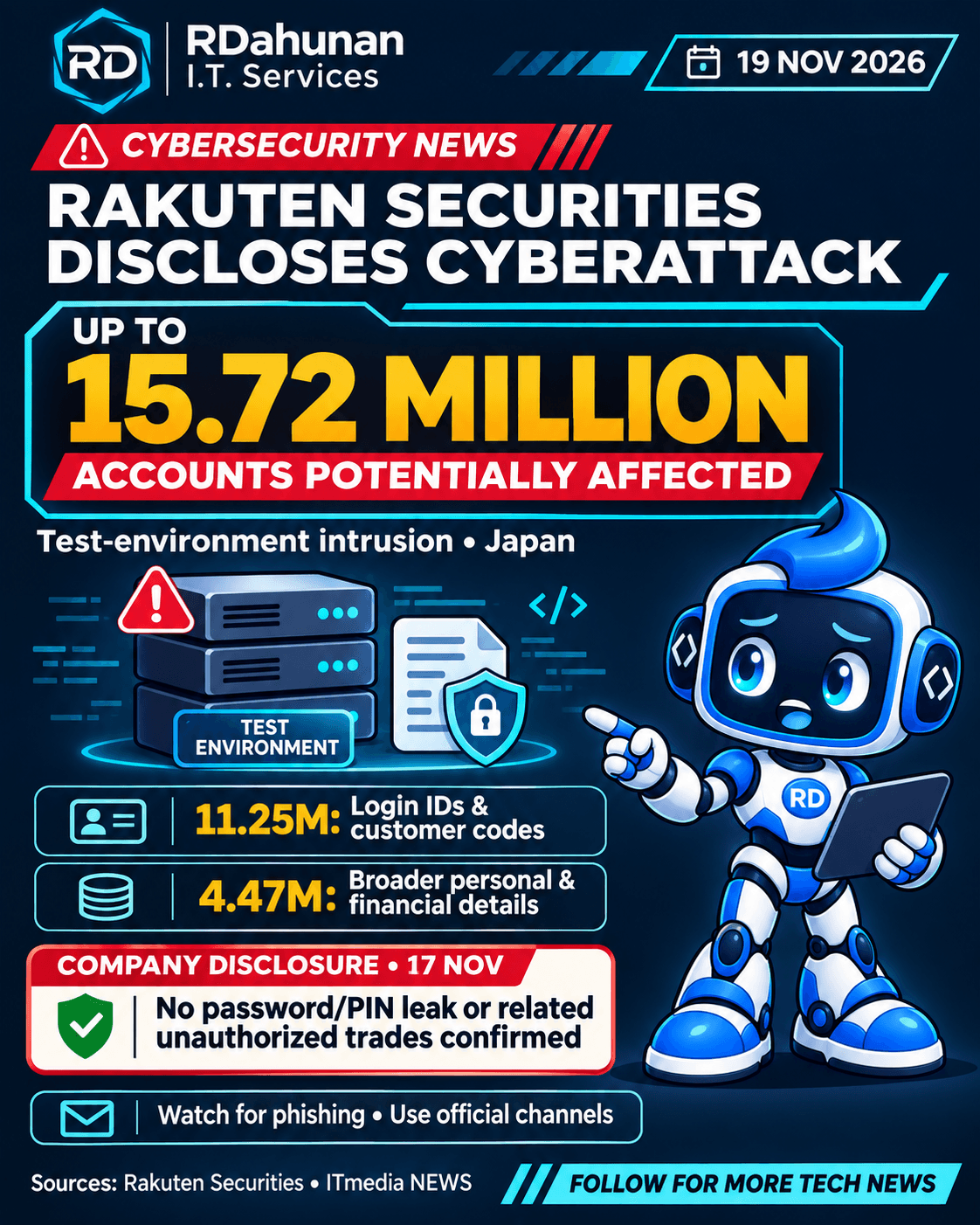
Rakuten Securities, a major online brokerage in Japan, disclosed on November 17, 2026 that some customer information may have leaked after a third party gained unauthorized access to part of its systems. The data was held in a test environment. In company-interview coverage, ITmedia NEWS reported the combined total as up to 15.72 million accounts potentially affected.
These are account figures. They are not a count of confirmed individual victims, and not a count of complete records stolen.
What Rakuten Securities disclosed
According to the company's official notice:
- On November 16, 2026, it detected possible unauthorized access by a third party to part of its systems. It blocked access to the affected area and applied corrections.
- Its investigation then found that some information managed in a test-environment system may have been taken out on November 11.
- The cause and the detailed sequence of events were still under investigation.
- It had finished identifying the affected customers and said it would report to them individually.
What information may have been exposed
The official notice lists two groups of accounts. Former customers who closed their accounts are included.
- Up to about 11.25 million accounts: branch and customer codes, and Rakuten Securities login IDs.
- Up to about 4.47 million accounts: branch and customer codes and login IDs, plus name (including the katakana reading), date of birth, address, phone number, email address, employer, withdrawal bank account (bank, account number and account holder), self-declared annual income and financial assets, asset information by product, and last login date.
The company says these login IDs are different from Rakuten IDs. ITmedia NEWS reported the two groups together as up to about 15.72 million accounts. A company spokesperson told INTERNET Watch that the combined figure covers nearly all, but not all, Rakuten Securities accounts. Not every account had the same information exposed.
What has not been confirmed
In its November 17 announcement, Rakuten Securities said it had not confirmed any leak of login passwords, PINs or other information needed for trading. It also said it had not confirmed any unauthorized access or unauthorized trades believed to be caused by the incident.
That statement describes what the company had confirmed at the time of its disclosure. The investigation was continuing, so it is not a guarantee that no harm occurred.
Why customer data was in a test environment
Test environments normally use dummy data. Rakuten Securities told ITmedia NEWS that part of a system upgrade required checking some functions with production data, so it copied part of its live customer information to a test server for a set period, without masking it. The company described this as an exception that went through formal internal procedures, and said the attacker exploited a vulnerability despite the security measures in place. It declined to say when the data was moved or how long the upgrade work lasted.
What affected customers should do
- Log in through the official Rakuten Securities app or website and check the important notices shown after login. The company says this is the most reliable way to see whether your account is affected; not every customer will receive an email.
- Set up passkey authentication if you have not already. Rakuten Securities says more than 90% of customers who log in each day already use passkeys.
- Consider the temporary trading and withdrawal suspension option in the security settings after you log in.
- Be careful with emails, text messages, calls and letters that claim to come from Rakuten Securities or related companies, including messages that offer breach compensation or ask you to verify your account. The company says its emails do not contain URLs and that it will not ask for personal or login information by phone.
- Never give login details, one-time codes or PINs to anyone who contacts you, even if the message looks official.
A lesson for businesses
Real customer data should not sit in a test system. If a test truly needs realistic records, mask or anonymize them first, keep the copy only as long as the test runs, limit who can reach the test server, and protect it as carefully as the live system. In the Philippines, the Data Privacy Act requires reasonable security measures for personal data wherever it is processed, and that includes development and testing copies.
About this update
This article is based on Rakuten Securities' official November 17 disclosure and Japanese news reports from November 18. We checked the official notice again on November 19, 2026 (Philippine time) and found no update that changes these facts. The figures describe potential exposure, not confirmed financial losses.
Follow RDahunan I.T. Services for more tech news and cybersecurity updates. This is independent news content with an AI-generated RDee illustration. RDahunan I.T. Services and ShopLinks PH are operated by the same team.
Sources
- Rakuten Securities: official disclosure, November 17, 2026 (Japanese)
- Rakuten Securities: official press release PDF, November 17, 2026 (Japanese)
- ITmedia NEWS: company interview and reported account total, November 18 (Japanese)
- INTERNET Watch: reporting and spokesperson clarification, November 18 (Japanese)