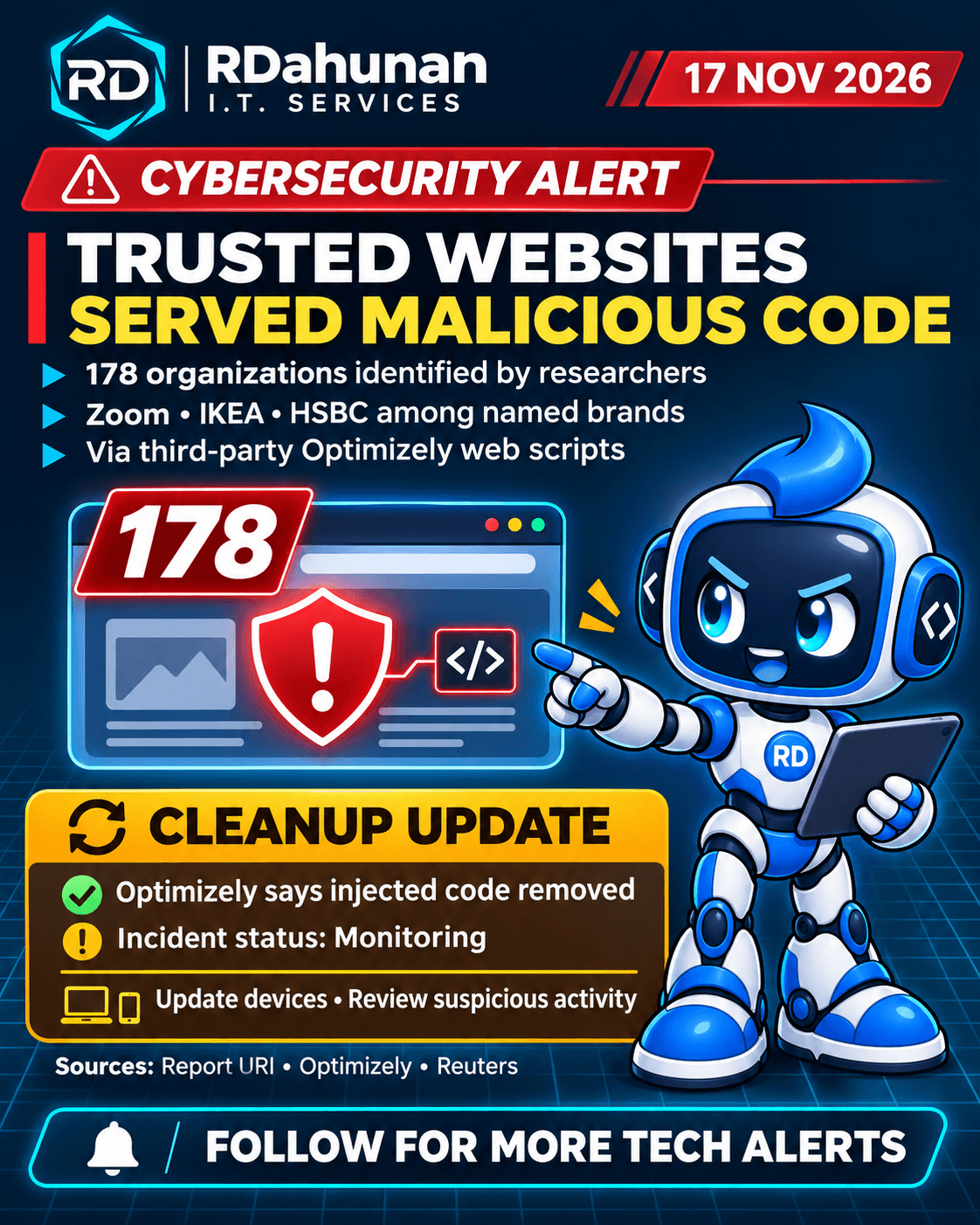
Cleanup update: injected code removed
Optimizely says it has fixed the vulnerability that was exploited and removed the injected code from affected customer projects. Report URI, the security firm that published the original investigation, said in a November 17 update that all of the infected Optimizely files it was tracking were clean as of 23:11 UTC on November 16 (7:11 AM on November 17, Philippine time) and had stayed clean since.
Optimizely's official incident page was still marked "Monitoring" at our 7:05 PM Philippine-time recheck on November 17, with no resolution time posted. The cleanup observation covers the files the researchers checked. It does not prove that every downstream effect has been reversed.
What happened
Optimizely Web is a third-party experimentation tool. Websites load it as a JavaScript file so they can test changes to their pages. According to Optimizely, an unauthorized party exploited a vulnerability in its Experimentation product and used it to add malicious JavaScript to some customer projects. The code reached visitors through each website's existing Optimizely script, so the affected companies' own servers did not have to be breached.
Report URI identified 178 organizations whose Optimizely scripts carried the code on November 16, 2026, and said the real number may be higher. Named brands include Zoom, IKEA and HSBC. The research lists specific websites: for IKEA it names the home-design site, and for HSBC it names HSBC's U.S. and Hong Kong websites.
The 178 figure counts organizations the researchers identified. It is not a count of confirmed victims.
What the code was designed to do
Report URI describes a script designed to:
- replace cryptocurrency wallet addresses on the page or clipboard with the attacker's addresses;
- skim payment card details entered on a page;
- target older, unpatched iPhones and iPads with exploit kits.
Report URI recorded cryptocurrency payments to wallets it attributes to the attacker. Reuters reported that a second security firm, Hudson Rock, also observed the malicious code, and that the scale of successful exploitation was unclear. How many visitors were actually affected has not been established.
What this does not mean
- Not every visitor to the named websites was compromised.
- The reports concern website scripts. They do not show that the Zoom app, bank accounts or banking systems were hacked.
- Optimizely has not marked the incident resolved; its status page says it is monitoring.
What you can do
- Install the latest supported security updates for your phone, computer and browser. For iPhone and iPad, Report URI points to iOS 18.7.3 or later, or iOS 26.3 or later.
- If you paid by card on an affected website around November 16, review your recent payment activity.
- If you sent cryptocurrency, check that the recipient address matches the one you intended.
- If you notice anything suspicious, contact your bank or service provider through its official app, website or hotline.
For website owners
Trusted third-party scripts can change even when your own code does not. Keep a list of the scripts your website loads, limit who can edit tag-manager and experimentation dashboards, and protect those accounts with multi-factor authentication. Report URI also recommends a Content Security Policy (CSP) with reporting turned on, so that unexpected script sources and data destinations are blocked or flagged.
About this update
Follow RDahunan I.T. Services for more tech news and cybersecurity updates. This is independent news content with an AI-generated RDee illustration. RDahunan I.T. Services and ShopLinks PH are operated by the same team.