News update · 8 November 2026
The Bureau of Internal Revenue is investigating online reports of an alleged data leak. A separate social-media claim puts the possible exposure at around 10 million taxpayer records. These are different propositions: an investigation is established by the sources reviewed; a verified breach and that record count are not.
What the official response establishes
The BIR’s public advisory acknowledges reports of an alleged leak and treats the matter as urgent. Bombo Radyo’s 7 November report identifies the DICT, National Computer Emergency Response Team, Cybercrime Investigation and Coordinating Center, and PNP Anti-Cybercrime Group as participating in the investigation.
GMA News reported on 7 November that the BIR had not specified the potential extent of the leak or the types of information that might be involved. The available advisory therefore does not tell an individual taxpayer that their own records were exposed.
What the reported 10M figure means
A BetterGov.PH screenshot reviewed for this article attributes the report about more than 10 million taxpayers’ records to Deep Web Konek. The original Facebook references are linked below. This article does not independently authenticate the alleged files, their origin, their contents or the number of unique people represented.
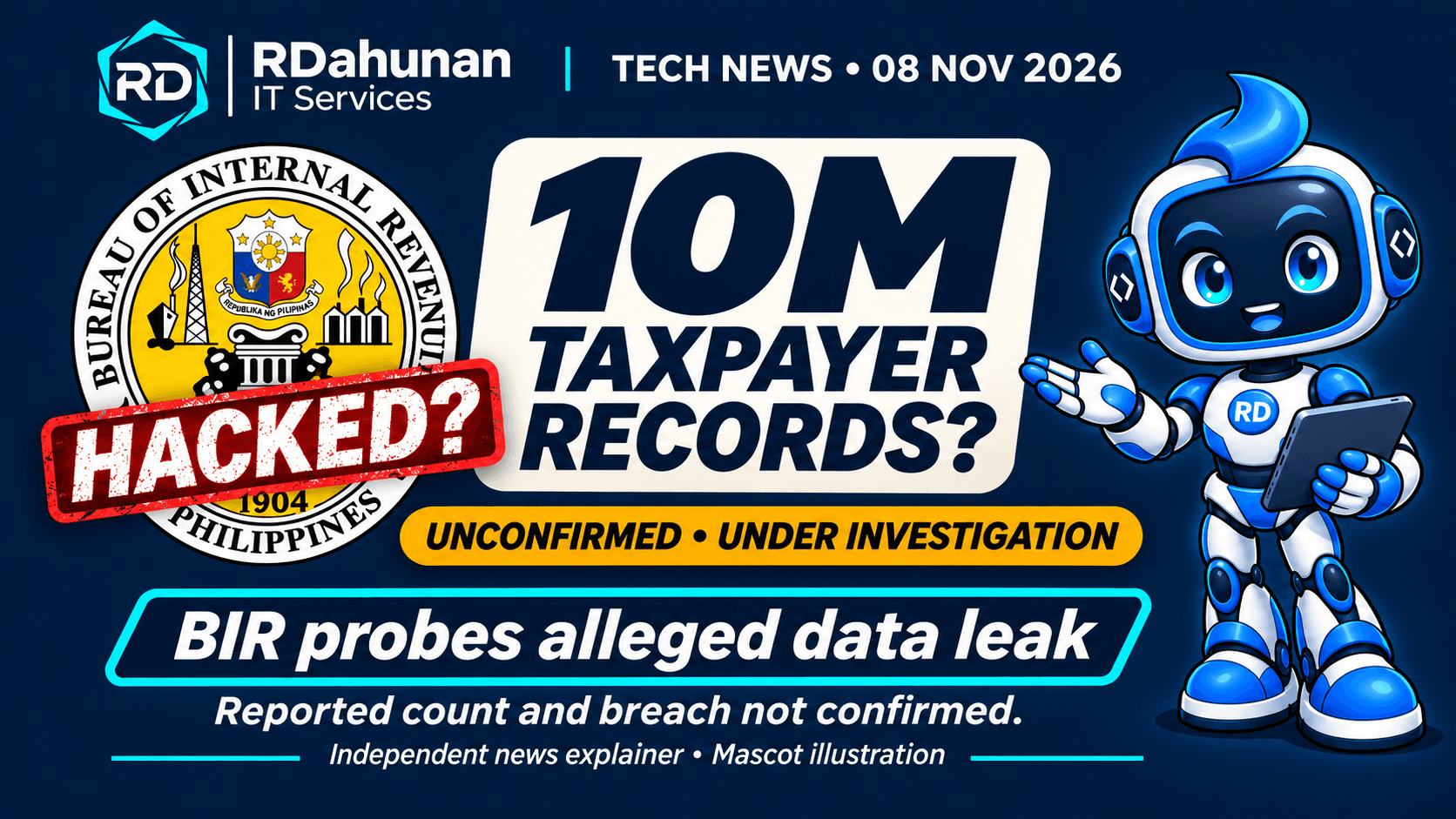
Records, people and accounts are not interchangeable measures. A headline saying “10 million accounts compromised” would go beyond what the reviewed official information establishes. The accompanying “HACKED?” graphic deliberately includes question marks and an unconfirmed label; it is an illustration of the allegation, not evidence that a breach occurred.
Practical precautions for taxpayers and business teams
An unresolved report is a reason to verify unexpected requests carefully. It is not a reason to submit additional sensitive documents to an unfamiliar website.
- Open the official BIR website independently when checking an unexpected tax-related message. Find contact details there rather than relying on the sender’s link or telephone number.
- Keep passwords and one-time codes private. Someone knowing your name, business name or tax-related details does not establish that they represent the agency.
- Do not upload IDs, TINs or tax returns to an unofficial service promising to check whether you are affected.
- Avoid downloading or redistributing alleged leaked records. Discuss the public report without exposing another person’s information.
These are general precautions consistent with the NPC’s anti-phishing guidance. They are not a finding that any reader’s records were exposed or that a scam campaign has been linked to this allegation.
What would resolve the uncertainty?
Further verified information would need to establish whether the files are authentic, whether they originated from BIR systems, which information is involved and who is affected. Any specific action for taxpayers should be checked against the agency’s official instructions as the investigation develops.
This independent RDahunan I.T. Services report reflects information reviewed on 8 November 2026. The RDee artwork is AI-generated editorial illustration and does not indicate government endorsement. ShopLinks PH and RDahunan I.T. Services are operated by the same team.
Sources
- BIR public advisory on alleged data-leak reports
- GMA News: BIR data leak under government probe, 7 November 2026
- Bombo Radyo: Umano’y data leak sa BIR, iniimbestigahan na, 7 November 2026
- Original Facebook reference 1, supplied with the reported claim
- Original Facebook reference 2, supplied with the reported claim
- NPC general anti-phishing guidance