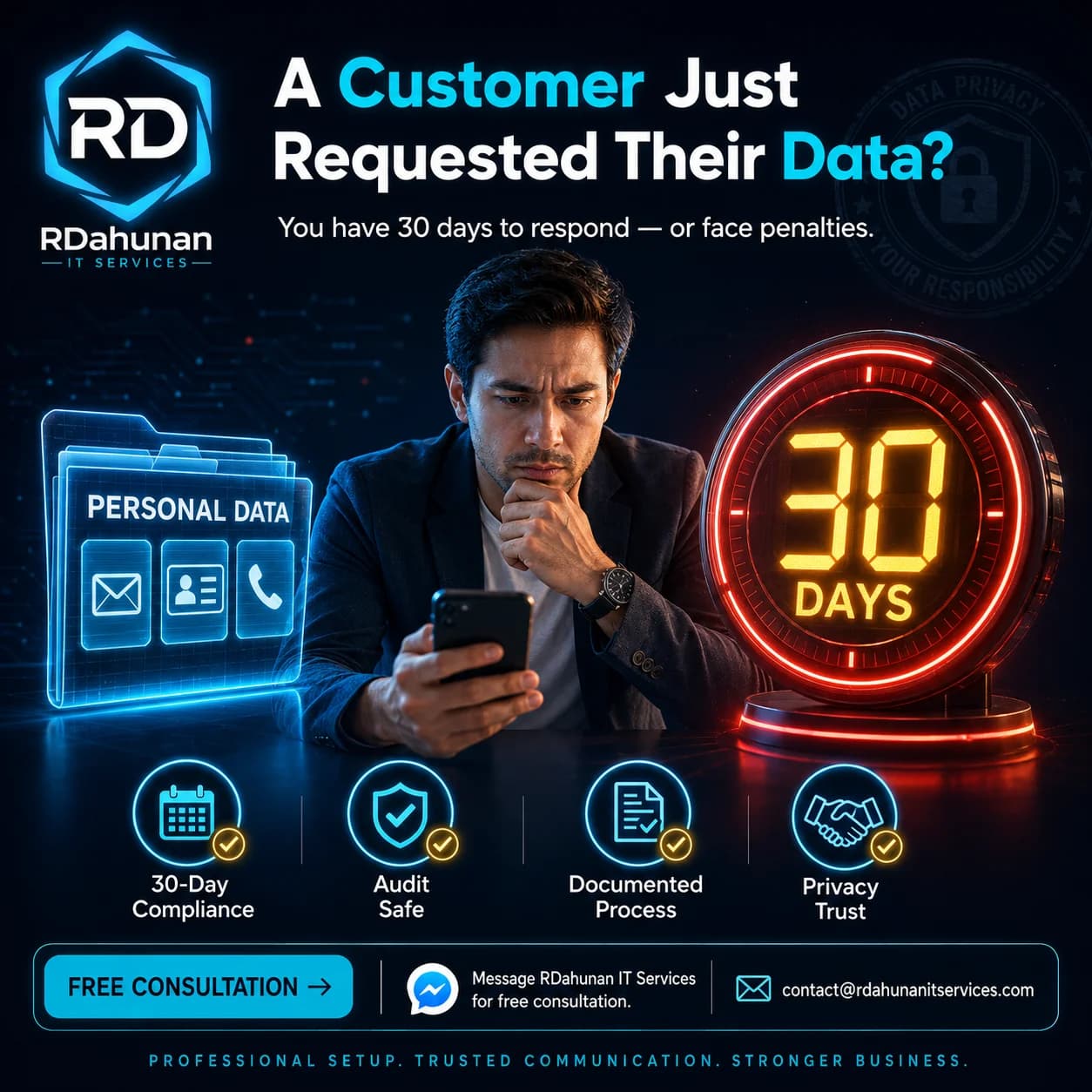
Your customer emails one Tuesday morning: "Per the Data Privacy Act, I am formally requesting a copy of all personal information your business holds about me."
This is a Data Subject Access Request (DSAR). Under Section 16 of RA 10173 and NPC Circular 16-01, you have 30 days to respond — or face administrative penalties under NPC Circular 2022-01.
Most Philippine business owners have never received one. Most don't have a process for when they do. This guide walks through the exact steps, from receipt to closure.
What a Data Subject Access Request Actually Is
A DSAR is the formal exercise of a data subject's right under Section 16 of the Data Privacy Act. The subject (your customer, employee, or anyone whose data you process) can request:
- Confirmation that you process their personal data
- A copy of that data in a readable format
- The purposes for which you're processing it
- The third parties you've shared it with
- The retention period applied
DSARs do not have to use any specific form, language, or channel. A Messenger DM saying "send me everything you have on me" counts as a DSAR.
The 7-Step Response Process
Step 1 — Acknowledge Within 72 Hours
Even before you investigate, send a written acknowledgment within 72 hours of receipt. Include:
- Confirmation you received the request
- The 30-day response deadline (calendar days from receipt)
- Your DPO's contact details
- A unique reference number for follow-up
Acknowledgment ≠ response. The 30-day clock keeps running.
Step 2 — Verify the Requester's Identity
You must confirm the request actually comes from the data subject (not an impersonator). Acceptable verification:
- Government-issued ID matching the data subject's records
- A signed authorization if filed by a representative
- A video call confirming identity for sensitive data requests
Never release data on identity verified only by an email address — that's a breach waiting to happen.
Step 3 — Search Every System That Holds Their Data
Document every place the subject's data may live:
- CRM
- Email inbox and outbox
- Accounting software (invoices, receipts)
- Inventory or POS system
- Backup files
- Paper records
- Third-party processors (GCash, J&T, hosting providers)
Skipping systems is the most common mistake. The NPC has fined businesses specifically for incomplete responses.
Step 4 — Compile the Response Pack
Prepare the response in a format the subject can actually read:
- Plain English summary of what data you hold and why
- Machine-readable export (CSV, JSON, PDF) of the actual data
- List of third parties the data has been shared with
- Retention periods applied per category
- Description of automated decision-making (if any)
Redact any third-party personal data inside the response — a customer is entitled to their own data, not their colleagues'.
Step 5 — Decide on Format and Delivery
Default to electronic delivery (encrypted PDF or password-protected ZIP). Use the email address on file unless the subject specifies otherwise. For paper records or large exports, courier with tracking is acceptable.
Step 6 — Send Within 30 Days
The deadline is 30 calendar days from receipt of the original request. Weekends and Philippine holidays do not pause the clock.
If the request is complex (multi-year records, large datasets), you may extend by an additional 30 days — but you must notify the subject of the extension and the reason within the original 30-day window.
Step 7 — Log the Response
Keep records of:
- Date received, acknowledged, and responded
- Identity verification method used
- Systems searched
- Documents released
- Any data withheld and why
These logs are what you produce when the NPC audits.
The 4 Valid Grounds for Refusal
You can lawfully refuse a DSAR in only these cases (NPC Advisory Opinion 2017-21):
- Manifestly excessive — the same subject has filed identical requests recently
- Disproportionate effort — the data is dispersed beyond reasonable retrieval
- Public order or national security — narrow exception, rarely applies to private SMEs
- Legal privilege — communications between you and your lawyer
"It's inconvenient" is not a valid ground. Neither is "the requester is annoying."
Common DSAR Mistakes
- Treating the email as customer service rather than a legal request
- Skipping identity verification and releasing data to an impersonator
- Forgetting backups, archives, or third-party processor data
- Including other subjects' personal data in the response (a separate breach)
- Missing the 30-day deadline because you "didn't see it in time"
Frequently Asked Questions
Can I charge a fee for processing a DSAR?
Generally no. The first request from a subject is free. Only repeated or excessive requests can incur a reasonable fee, and you must justify it.
What if my business is too small to have a CRM?
Your obligation is the same regardless of size. If you only have email and a spreadsheet, your DSAR response includes everything in both.
Does this apply to employee data too?
Yes. Employees are data subjects with the same rights. Common DSARs come from former employees requesting their entire HR file.
Don't Wait for Your First DSAR
The first DSAR is always stressful. The fifth one is routine — if you have a written process. A pre-built DSAR template, an identity verification script, and a documented search checklist take an afternoon to create.
At RDahunan I.T. Services we draft DSAR response templates, train DPO teams, and handle DSARs end-to-end for Philippine SMEs as part of our outsourced DPO service. Send us a message for a free 30-minute DSAR readiness check.
General DPO guidance. Not legal advice.